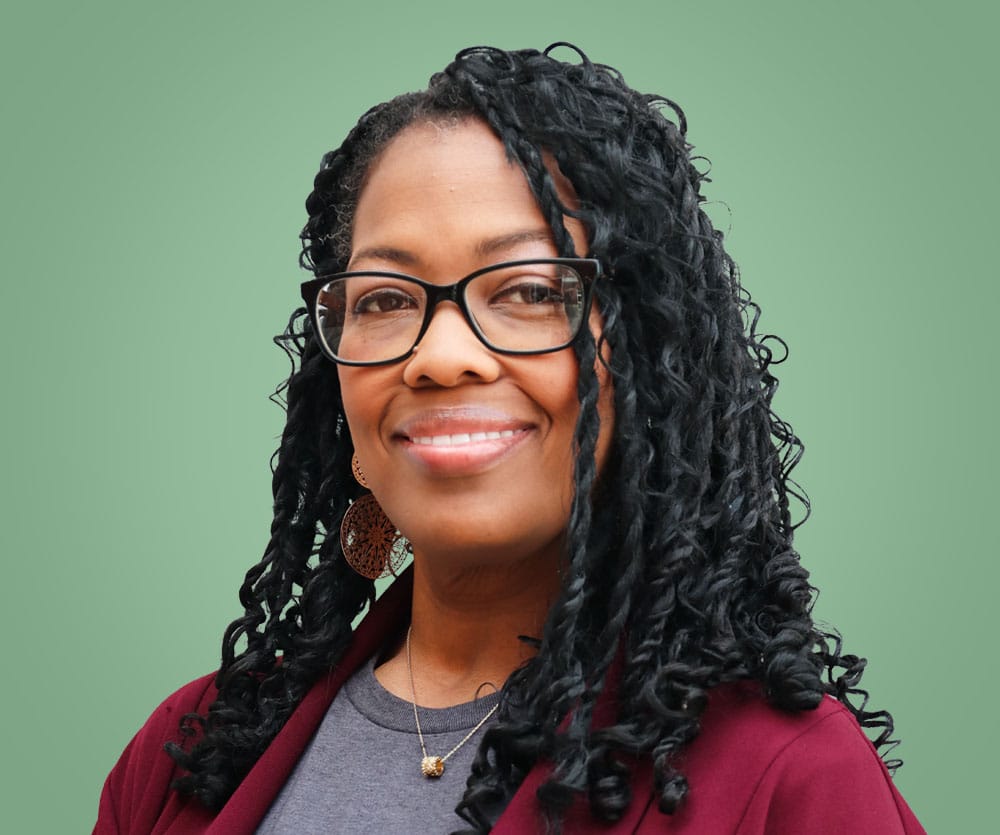
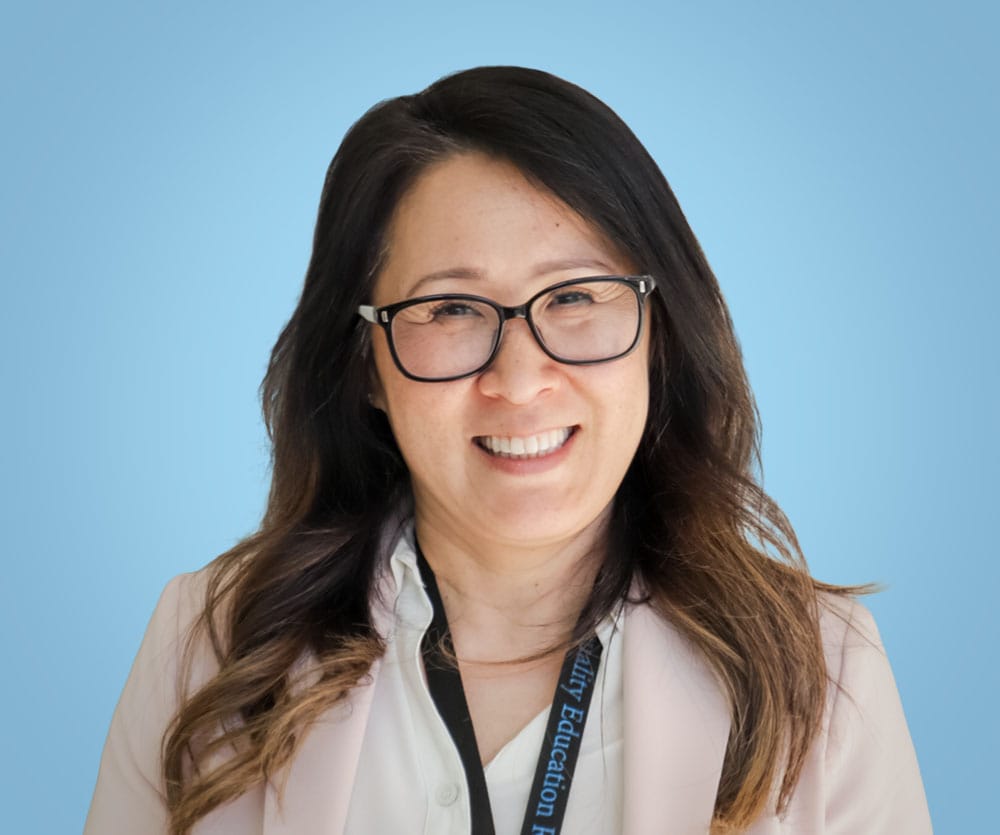
Jill Dwyer


May 2026 Honoree
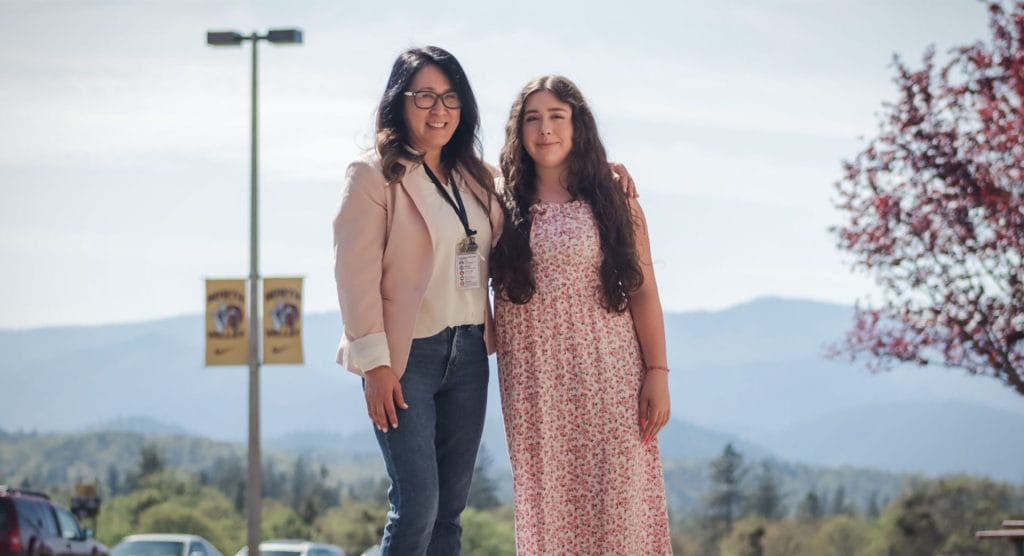
Jill Dwyer
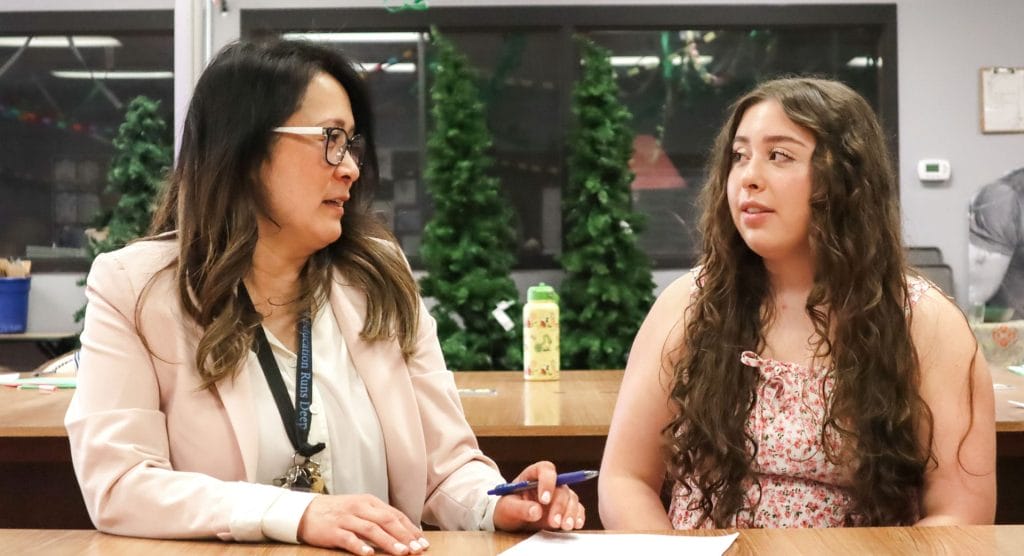
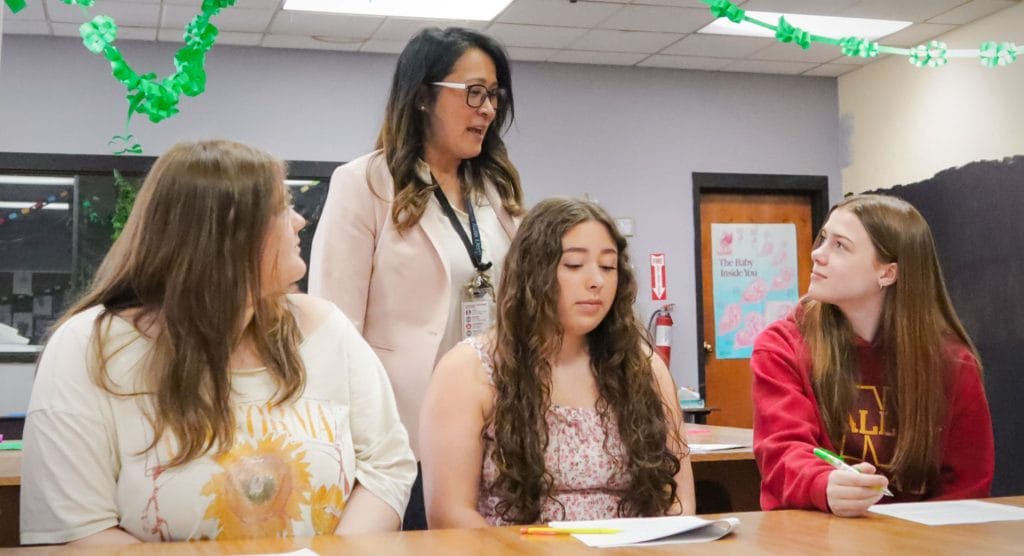
with her student, Ava Castro
North Valley High School
, Grants Pass
, Oregon
Sponsored by: Andrea & David Tracy
Available On:


LISTEN TO THE EPISODE
"If just one student can break that generational parenting style that maybe is not developmentally appropriate or abusive or dysfunctional and see that there are different ways to parent and handle this behavior, then that's a win."
Jill Dwyer
"She is genuinely the nicest person I've ever met, and she is so caring, and really just shows that you can make it through anything."
Ava Castro
"[Ava] has done a lot of great things that [she] wouldn't probably be able to do without Ms. Jill's support and her help and her knowledge of how to get things started."
Melissa Jennings
"Bev Boss was a preschool director and she was an expert in her field. And she had a saying that, 'Your childhood takes you by your hand for the rest of your life.' Which is so true."
Jill Dwyer
"Through watching [Ms. Jill's] actions, she taught me that altruism will make you successful, not egocentrism."
Ava Castro
"[Ms. Jill has taught Ava] to follow her dreams, just go for it."
Melissa Jennings
Description
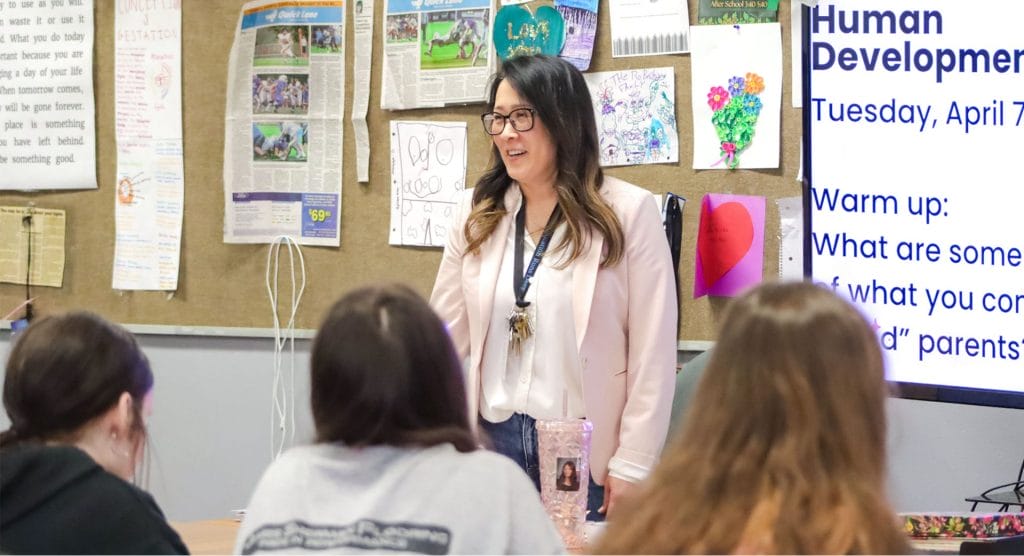
Jill Dwyer, an Early Childhood Development CTE teacher at North Valley High School in Grants Pass, Oregon, is the recipient of our May 2026 Honored National Teaching Award. She was nominated for this award by her student, Ava. Joining Jill in this episode are Ava and Ava’s mom, Melissa.
You’ll hear about:
- Jill Dwyer’s journey to becoming a teacher.
- The impact Jill has had on Ava and her family.
- Jill’s dedication to creating a safe and supportive environment for her students.
- Jill’s passion for hands-on learning experiences.
You’ll also hear from award-winning actress Jennifer Garner, as she shares about the teachers who left an incredible impact on their journey in our segment “Teachers Who Inspired”. Jennifer Garner has enjoyed a successful career at the top of her field in both film and television and has also taken on the role of philanthropist and entrepreneur. As a philanthropist, Garner is a Save the Children Trustee and has worked with the organization since 2008. In 2014, Garner joined the global non-profit’s board of trustees, deepening her commitment to issues affecting children in America and around the world.
Links Mentioned
- Nominate a teacher for our Honored National Teaching Award: https://www.honored.org/nominate/
- Read the incredible nomination for Jill Dwyer: https://www.honored.org/nominees/jill-dwyer/
- Listen to Jennifer Garner’s Honored Advocate for Teachers Award podcast: https://www.honored.org/honoree/jennifer-garner/
- Follow us on Instagram: https://www.instagram.com/honored/
- Follow us on Twitter: https://x.com/honored/
- Follow us on Facebook: https://www.facebook.com/Honored.org/
- Follow us on LinkedIn: https://www.linkedin.com/company/honored.org
- Follow us on TikTok: https://www.tiktok.com/@honoredteachers
Credits
-
- Music by DanaMusic: https://pixabay.com/users/danamusic-31920663/
- Music by AudioCoffee: https://www.audiocoffee.net/
Transcript
JILL DWYER: If just one student can break that generational parenting style that maybe is not developmentally appropriate or abusive or dysfunctional, if they can break out of that cycle and see that there are different ways to parent and handle this behavior, then that’s a win.
HANNAH BOWYER-RIVETTE: Hello everybody, and welcome back to Inspiring Teachers: The Honored Podcast, where we shine a spotlight on life-changing teachers across the country. I’m Hannah, your podcast host, and our podcast is brought to you by Honored, which is a national nonprofit organization dedicated to honoring and elevating great teachers nationwide. Every month of the school year at Honored, we select an exceptional educator in the United States to be the recipient of the $5,000 Honored National Teaching Award. To learn more about our organization, you can go to our website at honored.org.
We are so excited to have you listening in on another Honoree podcast episode. Today, we are joined by Jill Dwyer, an Early Childhood Development CTE teacher at North Valley High School in Grants Pass, Oregon. She was nominated for this award by her student, Ava. To help share the impact of Jill’s teaching, we are joined today by Ava and Ava’s mom, Melissa.
Before we dive into Jill’s story, we are excited to kick off our Honoree episode with our special segment, ‘Teachers Who Inspired, where we invite individuals to share a story about a teacher who had a lasting impact on their lives. Today, we’re thrilled to have our guest on our special segment, award-winning actress and recipient of the 2025 Honored Advocate for Teachers Award, Jennifer Garner.
She has enjoyed a successful career at the top of her field in both film and television and has also taken on the role of philanthropist and entrepreneur. As a philanthropist, Garner is a Save the Children Trustee and has worked with the organization since 2008. In 2014, Garner joined the global non-profit’s board of trustees, deepening her commitment to issues affecting children in America and around the world.
JENNIFER GARNER: I was dancing with a different teacher who moved away when I was little, and I moved over to Ms. Denton’s studio. And she is just a total, she’s still doing this. She’s a total powerhouse. She’s not doing all these things, but she was a math teacher at our high school. She had the ballet studio.
And then several nights a week, she had ballet company rehearsals. And the other nights of the week, she also ran, and still runs, our local community theater, which is renowned. Like people drive for hours to be in Ms. Denton’s productions. By the way, her name is Nina Lou Denton Pasinetti. She’s since been married.
Everyone calls her Mrs. Pasinetti, but her husband, Tom, understands that she is Ms. Denton to me, and I can’t change that. So apologies to anyone, she is Mrs. Pasinetti. Anyway, Ms. Denton, I had her. I did not have her for math, but for my whole childhood in ballet and in ballet company, and then also in the community theater.
And she was tough. She’s a real hard ass. She did not put up with anything. If you were five minutes late, you had to watch class. And sometimes I remember when I was little, I didn’t want to take class, so I hid in the hallway until it had been, like I was seven minutes late.
And so that day, she brought out costumes, and she let everybody but me try on costumes and play, and they all did all this fun stuff just to show me, “Kiddo, don’t mess with me. Be on time.” So from then on, I was always on time, because what was the point if she was going to torture me? You had to be on time. You had to wear black and pink. You had to have your hair properly in a bun.
You don’t leave class in the middle to get a sip of water. You know, now all these kids are so worried about being hydrated, like we had water every hour and a half period. That was it no matter what, and we’d have bright red faces sweating, and she’s like, “Yeah, you’ll get a break when class is over in an hour.” She was very, very tough.
I remember the first time she told me she was proud of me, is like one of those moments in my life that I remember, because she really does not still, she does not say these things lightly. And she means it when she says it. And it was after my eighth-grade year.
During my eighth-grade year, I think I won a scholarship to a summer intensive program at North Carolina School of the Arts, and it was this five-week program. And she was, I think she was the head of the West Virginia Dance Teachers Association or something. So with that hat on, she had to write to congratulate me for winning this scholarship.
And at the end of it, she said, “And personally, as your teacher, I want you to know I’m very proud of you.” And at the time, I didn’t save things. I wish I still had that card because I can still picture her handwriting. It still means so, so much to me. And that is a pretty great teacher, who can give you, I feel like, my work ethic.
I mean, my parents were such hard workers, but Ms. Denton demanded it of me and demanded that I show up. And she has such integrity. I never heard her curse. I never heard her complain, but she demanded the same of us.
HANNAH BOWYER-RIVETTE: Throughout the rest of the episode, we’ll share Jill Dwyer’s story and the incredible impact she has on her students and families. To start us off, you’ll hear from Jill, who reflects on what led her to her current position, using her expertise from her prior background to support high school students in their learning journeys.
JILL DWYER: So I was at a Child Development Center at one of the other high schools here in this town, and the high school teacher there, the Child Development Teacher, Kim Bennett, was instrumental in where I am now. She was a mentor, and she inspired me to be a better parent, and she turned out to be one of my best friends now. And she gave me all her curriculum when I started here, and she’s helped me immensely.
And so I came into this position because I was going through a divorce, and I needed to find a way, really just practical, I needed to support myself and my children. And I connected with a lady whose daughter was at my center, and her husband is actually the superintendent of our school district. So I’m like, hey, that’s a good connection, and we’d still keep in contact. And I said, “Hey, I’m thinking about being a Child Development teacher. I said, What are my options?”
Because right now, the only program is in Corvallis, which is three hours away, so that was not an option for me. And she said, “Hey, oh my gosh, we have this program for CTE teachers if you come from industry, and then you just have to take your teaching credentials.” And basically, the 12 years I was at the Grants Pass High School Child Development Center were equivalent to getting my bachelor’s and master’s.
HANNAH BOWYER-RIVETTE: Jill’s Early Childhood Development Class helps students build vital skills for the future. Through foundational skills such as time management, emotional intelligence, and critical thinking, her teaching reaches far beyond preparing students for a specific career path.
JILL DWYER: As far as academic content, I cover from conception through early childhood, which is age eight. And so just the fact that I tell my students, you’re going to probably become a parent one day, and if you don’t, you’re going to be an aunt or an uncle, or maybe you have younger siblings, or your friends are going to have children. So really, you can’t get through life without interacting with children at some point.
So if they kind of know the nuts and bolts of how children develop and what’s developmentally appropriate and best practice as far as interacting with children, if I can give them those skills, that aspect of what they learned from my class. But you also want to teach them time management and throw in some emotional intelligence and critical thinking.
So I try to do that with my curriculum as well. And I’m a huge believer in logical and natural consequence, and this is the time for them to figure out if they make a mistake or something doesn’t go the way they want it to, how do you figure it out and make it right? So, as far as the parenting aspect and that child development content that I’m teaching, my students right now don’t have that yet, because they’re not parents yet.
So I would say, in that aspect, the place I was before I’ve had students that have gotten married, had babies, and they remember what they learned in that class and how to interact with their kids and why kids do what they do.
HANNAH BOWYER-RIVETTE: To learn more about Jill’s impact, we talked with her student, Ava, who shares what led her to nominate her teacher. She reflects on the relationship they’ve built and how Jill creates an environment where students are comfortable sharing about their lives, knowing they will be met with understanding and guidance.
AVA CASTRO: Ms. Jill makes me feel seen and understood because she really is a great listener, and she also remembers a lot of things. And Ms. Jill is actively involved in my life and is someone whom I can be open about the challenges that I face at home and even within school. And she’s very attentive. Even when I was going through the college application process in the winter, she overheard and helped me get connections with her friend.
And so that way, I was able to get recommendations, and I got scholarships. I got into multiple colleges. And then she also was very open and honest about her life as well, which I think really can help people feel seen because it’s like, you’re open about your life, and it isn’t just like, “Okay, tell me everything about you, but I’m not going to share anything about myself.”
She’s a very reassuring person, and she’s been through a lot of adversity. Seeing how she is genuinely the nicest person I’ve ever met, and she is so caring, and really shows that you can make it through anything. And she is very loving and is like a mother to all of her students.
HANNAH BOWYER-RIVETTE: Jill’s influence extends beyond the classroom and into the lives of her students’ families. Ava’s mom, Melissa, shares about the growth she has witnessed in her daughter. From watching her build her confidence to gaining independence, Melissa expresses the comfort she feels in knowing there is an adult at the school who is helping her daughter grow.
MELISSA JENNINGS: I see it a lot, actually. She’ll come home beaming, “Oh, I did this with Ms. Jill, and Ms. Jill and I are doing this.” And it’s really comforting to know that she has someone at the school who’s a safe space for her, and someone who has her best interests. And I feel like Ms. Jill, I really appreciate her and the time that she gives to Ava, she’s like a mentor, but also a friend. And as a parent, knowing that there’s somebody at the school who’s there to support her.
They’ve done a lot of great things together, and I love that Ms. Jill listens to Ava’s ideas and then they make things happen. They’ve done a lot of great things that Ava probably wouldn’t be able to do without Ms. Jill’s support, her help, and her knowledge of how to get things started. Ms. Jill has also been kind of a staple in our house as far as conversation. So it’s something positive, and so Ava has a lot of great days because she has that support.
HANNAH BOWYER-RIVETTE: Jill’s teaching is rooted in a commitment to reaching every student in her classroom. Inspired by early childhood educator Bev Bos, Jill is passionate about sharing how childhood experiences shape the rest of our lives. With this in mind, she intentionally creates an environment where all students feel safe, valued, and supported, especially those who may not have a stable support system outside of school.
JILL DWYER: So Bev Boss, she was a preschool director, and she was an expert in her field. And she had a saying that, “Your childhood takes you by the hand for the rest of your life.” Which is so true. Everything you experience in childhood, good or bad, whether you wanted to or not, follows you through the rest of your life.
So I was fortunate enough to have parents who were super supportive, loving, kind, patient, and that carried me through now, because I carry that through for the rest of my life. And I know not a lot of students have parents who are supportive or loving, and they may be in an abusive, toxic, or not good environment at home. And so knowing that I could be there and be someone who maybe doesn’t have that same dynamic with them.
And foster that growth and development that children go through. And it’s so true, you never really know what someone is going through. You don’t. Just sitting here across from me at their desk, you never really know what they’re going through. And if I kind of keep that in mind, then it helps me also get through the day when there are misbehaviors, or because a lot of times that’s how that comes out.
If they’re not getting that at home, then it comes out as misbehavior in school. I think that it really makes me sad that some kids don’t have someone in their corner and someone to support them, or they feel like someone doesn’t care for them. So if I can do that, then why not?
HANNAH BOWYER-RIVETTE: An important part of Jill’s teaching is giving students the opportunity to practice what they learn. Through hands-on experiences working with children, students take ownership of their work, learn to adapt in the moment, and cement academic concepts through real-world applications.
JILL DWYER: Students, after we learn about fine motor, literacy, or math, we do an activity. So I bring children in. One child is my granddaughter, and then they bring their younger siblings in. And they plan the activities for them, and going back to Bev Boss, she says, “If it hasn’t been in the hand, the body and the heart, it can’t be in the brain.”
And especially for students or for teenagers, but basically everyone, if you’re not involved in it, and if you’re just sitting there taking in information, it’s not the same. Like you have to have hands on and be invested in it, interested in it, to learn something. So I’ve been exploring project-based learning. I think it’s the best way for students to learn. So I try to implement that into my class so they have more hands-on activities.
And then I see them, they take ownership, and they’re proud of what they’ve created. And I give them the domain, “Okay, you’re going to plan a fine motor activity that involves literacy or math.” And they can take that domain and run with it. And they’ll spend a few days, and they get really into it. And so I love that. They get excited about it and then when the children come in and they do the activities they love interacting, they all get excited about the kids coming in.
And if they do an activity and maybe it wasn’t quite as successful as they thought it was going to be or didn’t really grab the kids interest, then they’re able to assess that and say, “Okay, what can we do for our next activity?” Because they’ll notice that some of the activities the children gravitate more towards, so they’ll kind of say, “Okay, what did that group do? And why did that group have all the kids, and why did only one child want to come to my activity?” So it gives them a chance to kind of develop and grow, as far as what they’re going to do for their next activity.
HANNAH BOWYER-RIVETTE: Through her time in Jill’s classroom, Ava has gained a strong sense of selflessness and an awareness of others. Ava and her mom describe how Jill leads by example and has inspired Ava to be a confident, caring individual who takes chances and steps outside of her comfort zone.
AVA CASTRO: Ms. Jill has changed the way I think about who I am because she taught me to be selfless. And I feel like for a lot of my life, especially as an only child, I prioritized myself and my success. But through watching her actions, she taught me that altruism will make you successful, not egocentrism. That’s probably the best way to put it, because it wasn’t something she necessarily directly told me; it was more of just watching her care.
I realized that I need to take a different direction in life, and that’s what I need to do. And I want to be the kind of person who has built a community and become a person that people can rely on. And if you call me, I’ll show up if you need to be comforted through a hard time. I’m with you. If you need someone to talk to, I’m all ears. I mean, I’ve been someone who loves to talk to people and know about people’s lives, but I guess I really dug deeper.
And especially with the Garden Club that she helped us start, realizing how many kids are struggling and things that I didn’t know, and getting to know them more and support them through hardships in their lives, because a lot of them are facing food insecurity. And even being there to talk about their successes and stuff. And it really showed me a whole new perspective that I will use for the rest of my life and take with me to college and everywhere.
MELISSA JENNINGS: A lot of self-confidence, and also how she reflected back on herself, which will hopefully stay in her mind and keep her humble in that type of way. Just to also follow her dreams, just go for it, why not? To take chances because she has been taking chances, like the Garden Club. She suggested it, took a chance to try that, and it could have gone a no, it could have gone a yes. So just try, just do your best.
HANNAH BOWYER-RIVETTE: Expanding on the growth Ava has experienced, she and Jill share about the creation of the school’s Garden Club. With Jill’s support, Ava and her friends built this club to support students facing food insecurity and give back meaningfully to their school community.
AVA CASTRO: So, the Garden Club was actually not originally my idea; it was my friends. And we had talked about who we were going to find to help run it because we needed to have a teacher. And my immediate thought went to Ms. Jill. And so I asked her, and she said yes before I finished the sentence. And she started throwing out all these amazing ideas of what we can try.
And we do it every other Thursday, so that kids who have other activities can come join. And a major project we did this year was food boxes for kids struggling with food insecurity. So I talked to Ms. Jill, and she wrote up the project proposals and everything. And so she contacted all these people, and we got all these different farms and people at our school to donate, and, you know, their parents and things.
And she put in so much time to go and get the groceries and go shopping and fill out the boxes, and we were able to give a great food box for kids over Christmas break. And even now, we’re going to start doing urban planting and things. And we have just leveled out the soil, and we’re going to put the planters in so that we can beautify the school and also so that for any food we grow, we’ll donate back to the student body.
JILL DWYER: Well, outside there was a really large garden area with really old planter beds that were falling apart and full of weeds. And so every time I drive by, I thought, “Oh my gosh, that’s a great place for a garden.” And so when she approached me, I was like, “Oh my gosh, that’s awesome.” And also, I thought that it was amazing how she saw the need for food in our community and with our students. And that’s something that if you have never experienced it, you don’t truly know what it means.
And so I’ve never experienced not having food to eat, but I know that students, they dread breaks and weekends because they don’t have food, and that’s heartbreaking. And so if we can grow some food and incorporate it into our lunches, and our kitchen manager already said that would be awesome and amazing, and make more food baskets. And then also, I know Ava and her mom were integral in those food baskets, also, they went and helped and bought so much food too.
HANNAH BOWYER-RIVETTE: Through her time in Jill’s classroom, Ava has also become more comfortable with change and uncertainty, facing obstacles with confidence and a positive outlook. By taking the time to be part of her students’ lives and push them outside of their comfort zones, Jill is leaving a lasting legacy not only on students but on families as well.
AVA CASTRO: I feel like I’ve grown personally because I realized I need to be more open to change. It’s been something I’ve been trying to work on, but Ms. Jill has definitely helped me loosen up. And she’s taught me that no matter what obstacles life throws at you, you can overcome them. And if there are things that don’t work out, it’s not the end of the world.
So when I didn’t get into my dream school, I got waitlisted, Ms. Jill comforted me, and then she showed me all the highlights of the schools that I did get into, all the opportunities that I’m going to get, and how life is going to be great going down a different path. And she made me feel worthy and showed me that there’s light at the end of the tunnel. And one thing I love about Ms. Jill, she does a perfect mix of being empathetic towards people, but also pushing them to keep going, which I think is something that everyone needs.
And she can truly find the good in anything. Like, even when you’re like, “There’s no good,” she’ll be like, “But there is.” And she’s passed that trait on to me to look for the good, and everything, and her winning this award is a testament to that, because although she’s faced many struggles, she never let them become setbacks, just redirections. And she’s positively changing lives and is deserving of getting recognized for her noble efforts.
Not only is she an outstanding teacher, but she’s also a very nurturing person. And she really wants to be a part of the students’ lives. Because of her child development background, she realizes how important it is to have someone and how high school is such a developmental time, and how you really do need people in your corner, especially because you’re going through major transitions. And then even how she teaches, in general, about breaking trauma and generational cycles and things that people need to know.
Because especially where we live, where it’s very impoverished, and there are not many resources, there is a lot of abuse, there is a lot of food insecurity, there is a lot of adversity. And Ms. Jill sees that, and she wants to help people, and she really does do it, not for recognition, but it is natural for her. She doesn’t even think twice when she helps people. If you watch, she’ll be doing something and then also helping you because it’s not even a question for her, it’s an action.
MELISSA JENNINGS: And I also would like to thank Ms. Jill for not only being there for Ava, but also for supporting the other kids with all of those things that you spoke about. It is very important to have that in kids’ lives, to know that and to learn these things, and just have that love and support from someone that you can look up to; that’s always important. So thank you, Ms. Jill.
HANNAH BOWYER-RIVETTE: In wrapping up our conversation, Jill expresses that her goal is for students to know they are capable of breaking cycles. By helping them understand the “why” behind their choices, she empowers them to care and develop intentional relationships with others.
JILL DWYER: Academically, if just one student can break that generational parenting style that maybe is not developmentally appropriate or abusive or dysfunctional, if they can break out of that cycle and see that there are different ways to parent and handle this behavior, then that’s a win. Because parenting is generational. You parent the way you were parented, and they were parented.
And so educating them, as far as, a lot of people, I think, believe children are just mini adults, and they’re not, and so you have to approach them differently. So if I can get them at least to kind of, “Okay, well maybe this is why we don’t do this, or this is what we should do instead.” At least if I get the wheels turning and thinking about other options, then that’s a win for me as far as the academic portion.
But also, even something as simple as budgeting, because they have to plan a baby shower and they do the gift registry, they’re shocked, like, “A stroller costs $200?” “Yeah, that’s kind of a cheaper one too.” So, bringing in basic life skills that they’re going to need outside of the content of child development, I try to incorporate that in my class as well.
HANNAH BOWYER-RIVETTE: Thank you so much for listening and joining us today to learn more about Jill Dwyer, our May Honoree and recipient of the Honored National Teaching Award. To read more about her story, you can visit our website at honored.org or click the link in the episode description. If you have a teacher who you want to recognize and nominate for our teaching award, you can head to honored.org/nominate to recognize a teacher today. If you enjoyed today’s episode, you can follow us and leave us a review on whatever podcast platform you’re listening in from. Thanks again for listening, and make sure to tune in next month to hear the incredible story of our June Honoree.
Photography By:
Lyric Anderton
Your teacher could be featured on The Honored Podcast. Nominate them for our $5,000 Honored National Teaching Award!
More Honoree Stories
September
Madeline Gerena Franco
Whitney M. Young Magnet High School
Chicago, Illinois