Kim Watson


June 2022 Honoree
Kim Watson
with her student, Harrison Gattis
Sterling Montessori Academy and Charter School
, Morrisville
, North Carolina
Story By: Katherine Boone, Editorial Director, Honored
“We’re all unique, and everyone has some sort of challenge. Sometimes you can see right away what their challenge is and sometimes you may not, but just because it isn’t visible doesn’t mean it isn’t there.”
Kim Watson
After Kim Watson taught her class of first- through third-graders a lesson about three states of matter—solid, liquid, and gas—she took aside one student. “There’s a fourth state,” she whispered to 9-year-old Harrison Gattis. “Go look it up.”
With those words, Kim struck a match to tinder. At home that afternoon, Harrison discovered the properties of plasma; he then moved on to the elusive fifth state, known as Bose-Einstein Condensate, which launched him on a self-directed journey toward particle physics and astrophysics. He’s now learning the theory of relativity (“General,” he qualifies. “I haven’t gotten to special relativity yet.”) and has his sights set on becoming an astrophysicist.
Editor’s Note: The original version of this story referred to the Bose-Einstein Condensate as the fourth state of matter, omitting plasma. Upon reading it, Harrison asked his mother to email the author: “Bose-Einstein Condensate is the 5th state of matter. Plasma is the 4th. You know, it’s really weird to correct adults.”
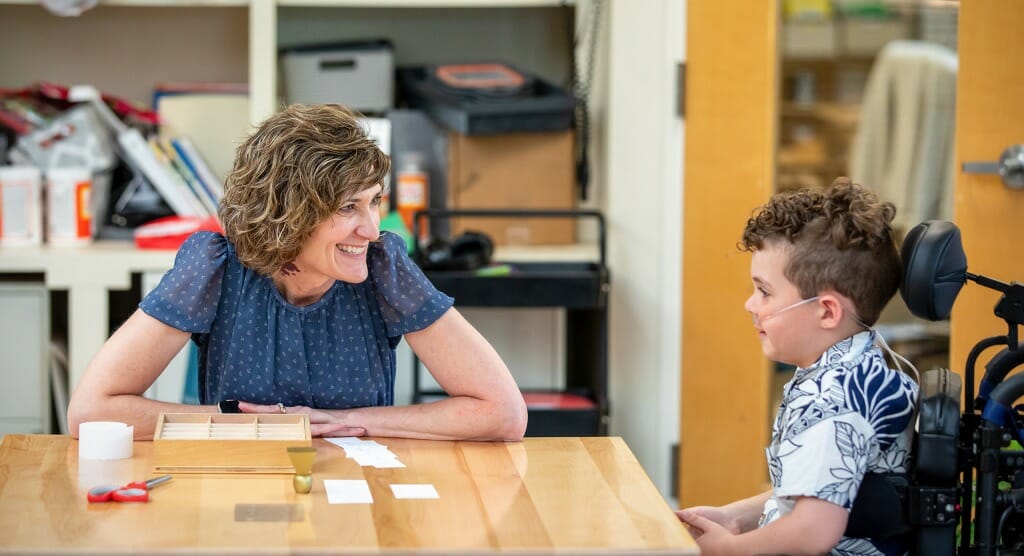
Though it may be unusual for a third grader to be studying relativity, Harrison says he is “used to feeling a little different.” He has a rare type of muscular dystrophy as well as a mitochondrial disorder, which together significantly deplete his strength and endurance. He is only able to attend school for two-and-half hours a day and uses a wheelchair while there to conserve his energy for learning. Harrison also brings with him supplemental oxygen, tube feeds, and IV infusions as well as a devoted Labradoodle named Miles who serves as an extension of Harrison, picking things up, delivering things around the classroom, and even alerting when Harrison’s heart rate or oxygen get too low. His mother, Sarah Gattis, rounds out the team by accompanying Harrison to school each day to attend to his medical needs. “It’s a lot of gear,” says Sarah with a laugh.
Despite such daunting physical obstacles, Harrison’s spirit remains undimmed. “Harrison is my super outgoing kid,” Sarah says. “He’s very funny, loves to be the center of attention, and he’s extremely smart.” He wears his curls in a faux hawk and had his ears pierced last summer. “He’d wanted them pierced forever, so we finally did it in August,” Sarah says bemusedly. To commemorate his recent brain surgery, he had a shirt made that says, “Brain Surgery: Been There, Done That.” His favorite books? “Astrophysics for Young People in a Hurry; Astrophysics for People in a Hurry; War and Peace,” he deadpans. That answer captures Harrison’s most essential qualities: a precocious and powerful intellect paired with a sparkling sense of humor. And while he may not be reading Tolstoy just yet, he is perfectly serious about studying Neil DeGrasse Tyson’s astrophysics tomes, both for children and adults.
“Instead of focusing on his limitations, he has always found a way around it,” Sarah says. “It has been awe-inspiring to watch. That’s the part of him that I like the most. He loves, loves, loves education: he just soaks it up, and he seeks out learning outside of school.”
“I’ve never steered away from a challenge if it was going to help me reach my goals with a child.”
Kim Watson
The Gattis family first got to know Kim in the summer before Harrison and his twin sister Grace began first grade at Sterling Montessori, a K-8 public charter school in Morrisville, North Carolina. Because Sterling has mixed-age classrooms, Kim would be their teacher for the next three years. “Kim met with us before the school year started and said, ‘Let’s figure out what we need to do to make this work,’” Sarah recalls. “And I was so relieved, because I knew she had a plan for Harrison. And for Grace. And not only that, she had a plan like that for every single kid in the class.”
Grace was instrumental in helping Harrison settle into Kim’s classroom. “They have such a special relationship,” Kim remembers. “When he needed something, Grace would just appear. You would think she wasn’t paying attention, and then there she was. It was beautiful.”
Over the next three years, Kim diligently nurtured and challenged Harrison’s voracious appetite to learn. “Harrison had different needs than I had experienced previously in my career,” Kim admits. “But I’ve never steered away from a challenge if it was going to help me reach my goals with a child.”
And Kim’s goals for Harrison were sky high. “Previously, teachers didn’t push him. I think they were afraid to push him,” Sarah says. “But Kim has never been afraid to push his boundaries. She knows he can do more, she wants him to see what he can really do. And then he really is motivated to show her what he can do, what he’s capable of.”
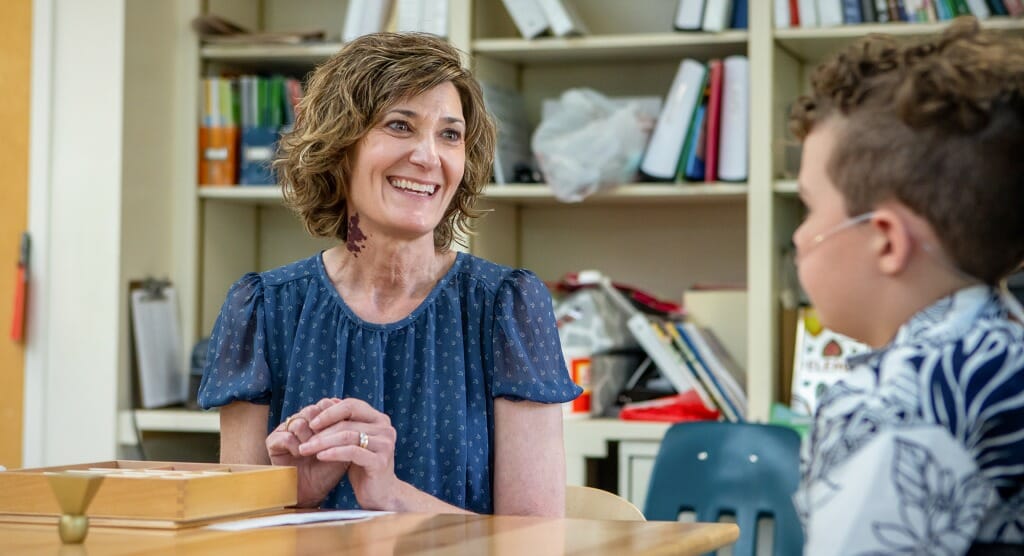
Kim Watson didn’t grow up dreaming of becoming a teacher; but over the years she found that the part of every job and experience she liked best involved teaching, from helping her younger brother with his school work to training new hires at the restaurant where she worked. Kim earned her teaching degree and then worked for a few years as a substitute teacher and support staff before getting a job as a third-grade teacher at another school. After seven years, Kim felt frustrated and burned out: “I had reached a place where I wasn’t able to do what I wanted to do; I wasn’t able to meet the needs or follow the interests of my students because of testing requirements. There was just so much testing.” With a heavy heart, she resigned. “I didn’t think I would ever go back to teaching,” she says.
A decade after she left teaching, Kim’s own son got a spot through the lottery at Sterling Montessori, where she found a school culture that mirrored her own beliefs about education. She put herself through Montessori training and has been teaching at Sterling for the past eleven years.
Kim’s philosophy as a teacher has always been to “follow the child;” and she found that at Sterling, she was able to let the interests and passions of every child direct her teaching. “Kids can play a huge role in their own learning. As educators, we can be very focused on what curriculum is in front of them, but if we take a step back, they can show us what it is they need, and it’s often not what we think they need.”
“It’s not my disability that’s the problem, it’s accessibility."
Harrison Gattis
Because the Montessori method involves so many many tactile experiences, Kim has had to think creatively about how to give Harrison those same experiences and prompts when his physical needs and abilities were different from his peers. She made him a special cart so that all of the supplies were readily available to him, and she adapts the lesson plans to accommodate Harrison’s abilities. “She changes her teaching strategies for him so that he can access the materials in a different way than his peers do,” Sarah says.
“It’s not my disability that’s the problem, it’s accessibility,” says Harrison, who has become an outspoken advocate for disability awareness. And to Sarah, that is what is most remarkable about Kim’s teaching: “She makes his learning accessible,” she says. Kim’s eagle-eyed attention to Harrison’s physical needs allows him to access the full range of his intellectual capacity. For example, when Kim noticed that Harrison’s hands were tiring too quickly to write, she got him a voice-to-text computer and encouraged him to try poetry—for which he has since won awards.
After three years in the classroom together, Kim and Harrison “got to know each other on a deeper level,” Kim says. “I can’t imagine going back [to a non-Montessori school] and losing them after a year—that’s just when you start to know who they are. The second year you build that relationship, and the third year it takes off. You really have to have that time to get to know the child to be able to help them the best that you can, to know them well enough to know when to push and when to pull back.”
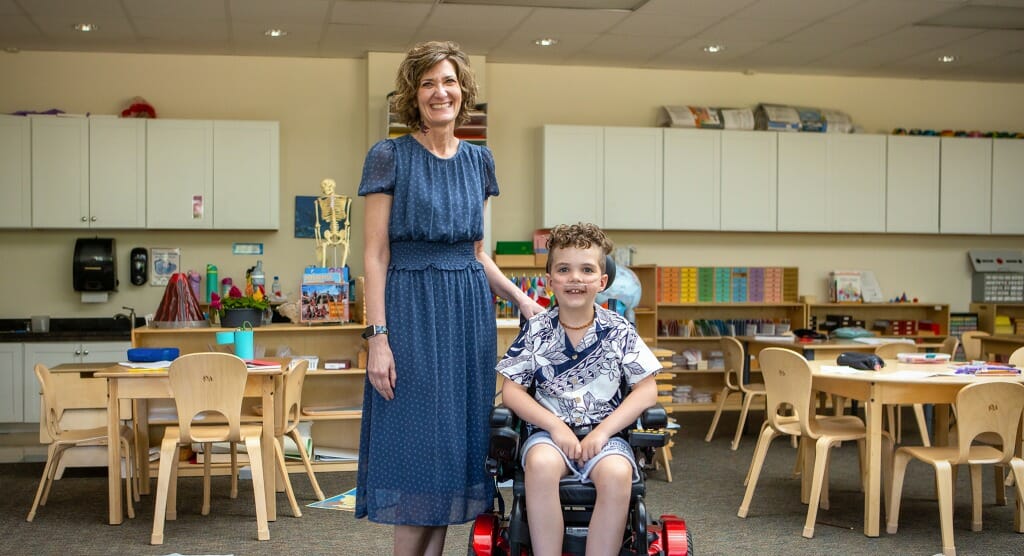
Perhaps what’s most exceptional about her story is that to Kim, teaching Harrison hasn’t been exceptional at all. She approached Harrison’s education the same way she approached the education of every single one of her students: by constantly adapting to the children’s needs, interests, and abilities. “This is just an extension of what I do for all my kids,” Kim says. “We’re all unique, and everyone has some sort of challenge. Sometimes you can see right away what their challenge is and sometimes you may not, but just because it isn’t visible doesn’t mean it isn’t there.”
Though Harrison and Grace will soon graduate to 4th grade, their three years with Kim have left an indelible mark on the whole Gattis family. While recovering from his recent brain surgery, Harrison wrote his Honored nomination story about Kim (using his voice-to-text computer) as a way to do something constructive with his time—a testament in itself to both the initiative and articulacy Kim has instilled in him that will transcend his time in her classroom. “Kim has given him a lot of confidence in himself,” Sarah says. “He knows he’s capable. Now even if others in the future don’t, he will expect that of himself.”
Photography By:
Ben McKeown
Your teacher could be featured on The Honored Podcast. Nominate them for our $5,000 Honored National Teaching Award!
More Honoree Stories
September
Madeline Gerena Franco
Whitney M. Young Magnet High School
Chicago, Illinois