


November 2025 Honoree
Hui Couch
with her students, Kelia Akariza, Juan Corona Martinez, and Obama Bijoux
Newcomer Academy, Louisville, Kentucky
LISTEN TO THE PODCAST EPISODE HERE:
Subscribe: Apple Podcasts, Spotify, YouTube, Amazon Music, RSS
story by: Inspiring Teachers: The Honored Podcast,
"I truly believe that the diversity of languages in my room is our greatest asset."
Hui Couch
Hui Couch, a 9th-grade Algebra teacher at Newcomer Academy in Louisville, Kentucky, is the recipient of our November 2025 Honored National Teaching Award. She was nominated for this award by the Modern Classrooms Project, a nonprofit organization that equips teachers to redesign their classrooms with blended, self-paced, mastery-based practices that personalize learning and strengthen student engagement. To help share the impact of Hui’s teaching, we are joined today by three of her students, Juan, Obama, and Kelia.
You’ll hear about:
- Hui Couch’s journey to becoming a teacher.
- The impact Hui has had on her students.
- How Hui utilizes the Modern Classrooms Project method to teach her Algebra class with nine home languages.
- Hui’s dedication to equipping her students with lifelong skills such as empathy, independence, and resiliency.
You’ll also hear from Kareem Farah, the CEO and Co-Founder of the Modern Classrooms Project, as he shares about a teacher who left an incredible impact on their journey in our segment “Teachers Who Inspired”. Kareem began his career as a high school math teacher in Hawaii and Washington, DC. Instead of using a traditional lecture model, Kareem taught mathematics through a blended model where students accessed content through his self-made videos.
In 2018, he received the DC Public Schools Award for Classroom Innovation and was featured in Edutopia and CBS News for his work. In an effort to scale his classroom model, Kareem co-founded the Modern Classrooms Project. As CEO, he has led the organization to become a nationally recognized leader in instructional innovation, training, and supporting over 20,000 educators across diverse schools and districts.
LINKS MENTIONED:
- Nominate a teacher for our Honored National Teaching Award: https://www.honored.org/nominate/
- Learn more about the Modern Classrooms Project: https://www.modernclassrooms.org/
- Follow us on Instagram: https://www.instagram.com/honored/
- Follow us on Twitter: https://x.com/honored/
- Follow us on Facebook: https://www.facebook.com/Honored.org/
- Follow us on LinkedIn: https://www.linkedin.com/company/honored.org
- Follow us on TikTok: https://www.tiktok.com/@honoredteachers
CREDITS:
-
- Music by DanaMusic: https://pixabay.com/users/danamusic-31920663/
- Music by AudioCoffee: https://www.audiocoffee.net/
EPISODE TRANSCRIPT:
HUI COUCH: I truly believe that the diversity of languages in my room is our greatest asset. This year, I actually have nine different home languages in the class. I have watched the students who started the year silent become more confident and active participants now, and the way they show empathy for one another really proves we are a learning community.
HANNAH BOWYER-RIVETTE: Hello everybody, and welcome back to Inspiring Teachers: The Honored Podcast, where we shine a spotlight on life-changing teachers across the country. I’m Hannah, your podcast host, and our podcast is brought to you by Honored, which is a national nonprofit organization dedicated to honoring and elevating great teachers nationwide. Our mission is to inspire and retain great teachers, keeping them in the classroom as long as possible. Every month of the school year at Honored, we select an exceptional educator in the United States to be the recipient of the Honored National Teaching Award. Each Honoree, as we call them, receives a $5,000 cash reward, and we then tell the story on our website and our social media platforms of how that teacher has impacted their students’ lives. To learn more about our organization, you can go to our website at honored.org. While you’re there, if you have a teacher you would like to recognize, you can nominate them at honored.org/nominate.
We are so excited to have you listening in on another Honoree podcast episode. Today, we are joined by Hui Couch, a 9th-grade Algebra teacher at Newcomer Academy in Louisville, Kentucky. She was nominated for this award by the Modern Classrooms Project, a nonprofit organization that equips teachers to redesign their classrooms with blended, self-paced, mastery-based practices that personalize learning and strengthen student engagement. To help share the impact of Hui’s teaching, we are joined today by three of her students, Juan, Obama, and Kelia.
Before we dive into Hui’s story, we are excited to kick off our Honoree episode with our special segment, ‘Teachers Who Inspired’, which is featured at the beginning of each episode. Here, we invite well-known individuals to share a story about a teacher who had a lasting impact on their lives. These stories remind us that behind every great achievement, there’s often an inspiring teacher who believed in their potential.
Today, we’re thrilled to have our guest on our special segment, Kareem Farah, the CEO and Co-Founder of the Modern Classrooms Project. Kareem began his career as a high school math teacher in Hawaii and Washington, DC. Instead of using a traditional lecture model, Kareem taught mathematics through a blended model where students accessed content through his self-made videos. In 2018, he received the DC Public Schools Award for Classroom Innovation and was featured in Edutopia and CBS News for his work.
In an effort to scale his classroom model, Kareem co-founded the Modern Classrooms Project. As CEO, he has led the organization to become a nationally recognized leader in instructional innovation, training, and supporting over 20,000 educators across diverse schools and districts. Kareem is also a member of Honored’s Board of Directors.
KAREEM FARAH: There are a lot of teachers during my elementary, middle, and high school career that I think had a pretty big impact on me. But I would say in high school, my Probability and Statistics teacher, Mr. Seechin, who is one of my favorite teachers of all time. I think there were a couple of reasons that his classroom was so impactful upon me as an advisor and teacher. One, I think he saw his role as a teacher to be equal parts content and relationship building, and that was clear in the way that he communicated, and that was clear in the way that he allocated his time.
And the consequence of that is that I felt like when I was walking into his classroom, there was a person there to guide me through a content journey, but there was also a person there who was trying to guide me to be a better person that was going to realize my full potential beyond the content. I think, especially as you look at K-12 education today, where there’s a lot of questions about whether the content is particularly relevant to most students, the ability for educators to build relationships and service sort of guides for kids, particularly at those secondary levels, is super impactful.
I spent almost every lunch period with Mr. Seechin. I made some of my biggest life decisions with his input in mind, and for that reason, I think he changed the trajectory of my life, but also is the teacher that sort of stood out as someone who embodied what I think is required of great teachers, honestly, unfairly so, because the job is so hard, but what is required, particularly at secondary.
HANNAH BOWYER-RIVETTE: Throughout the rest of the episode, we’ll share Hui Couch’s story and the incredible impact she has on her students. To start us off, you’ll hear from Hui, who shares what led her to teaching as she followed in her mother’s footsteps, and how she discovered the Modern Classrooms Project model.
HUI COUCH: I followed in my mom’s footsteps without a second thought. She is a retired teacher, a kind and successful teacher, and a leader. What inspired me most was how she cared for every student like they were her own. When I was very young, I remember her students often joining us for dinner in my house. After dinner, she would help them with homework, and also, so many nights, I watched her sew clothes on the sewing machine in the very dim light for her students who needed help. Her students all called her school mom at that time. Honestly, I was jealous of her students. I thought she loved them more than she loved me.
"From my mom, I learned that teaching is really about caring, love, and service."
Hui Couch
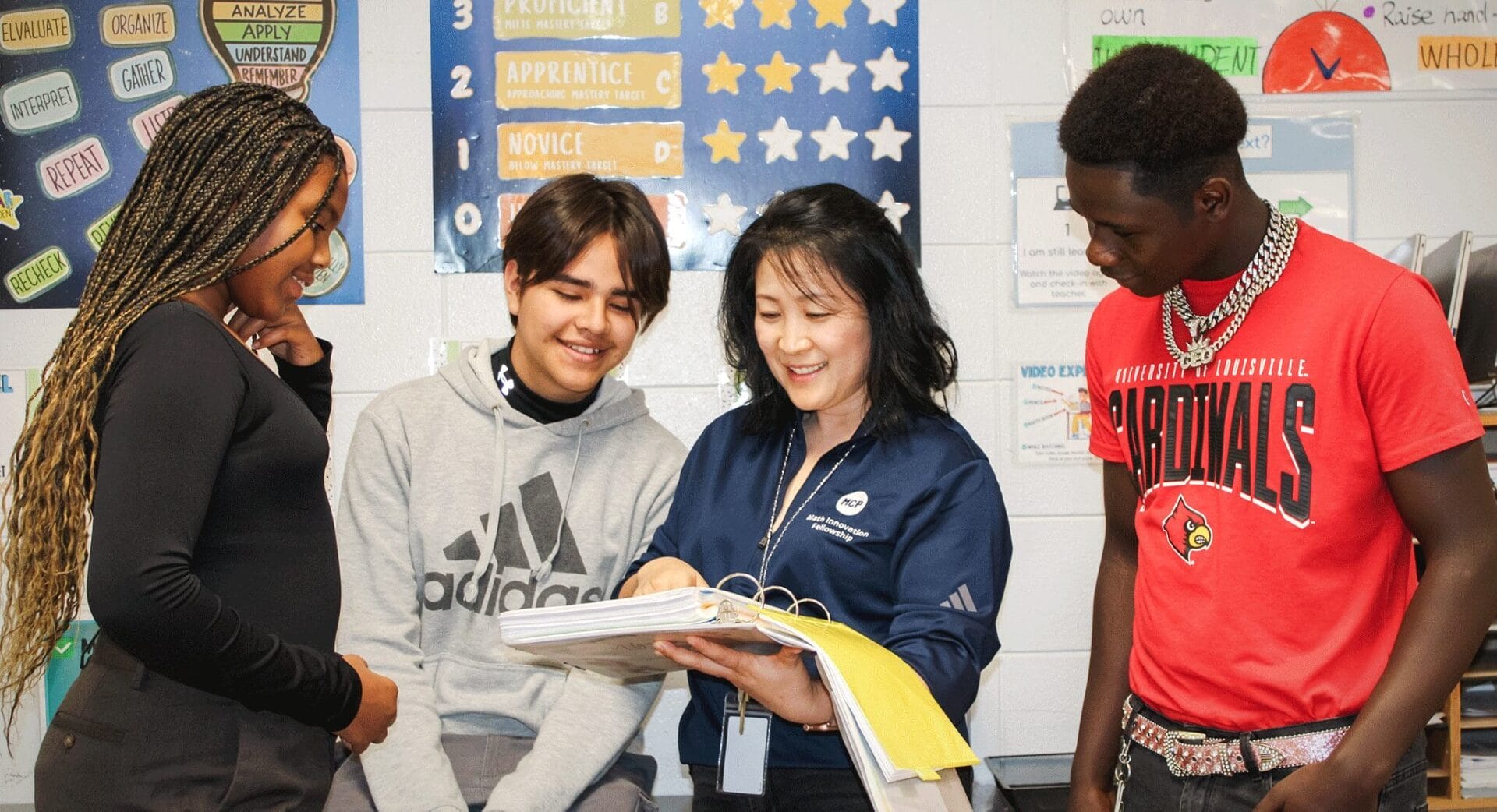
HUI COUCH: So, becoming a teacher felt natural to me when I grew up. I started my teaching career in China in 1998 when I graduated from college. In 2012, I came to work in the United States as an exchange Chinese teacher. I got my master’s here and began to teach Math. Currently, I’m working on my Ed.S program.
Teaching in the traditional way, the whole class, front of the room style, made it very hard for me to meet every student’s needs, especially after COVID. Students had just come out of the COVID lockdowns with all different kinds of academic gaps and social challenges, so standing at the front just wasn’t reaching every student for me. I knew I needed a different teaching approach to better help my students. So my principal, a very innovative and supportive leader, shared the Modern Classrooms Project with us through email and encouraged all the teachers in our school to explore it.
After I did a brief research online, I realized that the Modern Classrooms Project was exactly what I had been looking for. Students work at their own pace, take ownership, and focus on true mastery. It also frees the teachers up to spend more time in one-on-one or small group instruction. Without hesitation, I signed up for the training and began implementing MCP in my class. Now I am in my third year with the MCP, and I have the privilege of serving as a mentor myself. It’s an honor to support other educators on their MCP journey
HANNAH BOWYER-RIVETTE: At Newcomer Academy, the goal is to provide a welcoming and respectful environment to meet the needs of sixth through twelfth-grade English language learners. In Hui’s classroom, she teaches beginning English language learners who speak nine different home languages. With the Modern Classrooms Project method, Hui has the flexibility to meet students where they are so they feel supported and challenged, no matter their pace or language level.
HUI COUCH: In my classroom, I use a clear Modern Classrooms routine with step-by-step procedures, so students always know what to do and what is expected. When they arrive, we do a quick social-emotional check-in. They grab the handout and begin with the whole group warm-up. So as the students work, I circulate to ask questions to stretch their thinking, encourage math talk, and monitor their process.
Students collaborate in groups to discuss the questions, brainstorm ideas or solutions, and solve problems with my assigned group rules, a group leader who keeps the discussion on track, and a resource manager, I usually call them, “Math Coach”, who supports the group by giving suggestions, strategies and handling tools like a Google Translate or Manipulatives, if necessary. After group work, students check their work. If they catch mistakes, they are not allowed to move on.
They need to rewind and talk through their misconceptions and correct their wrong answers. Then I release them to their self-paced learning, and they rotate through different stations. So while stations are running, I pull individuals or small groups to work with me. So at the end of a class, we usually regroup as a class and debrief how they worked toward our learning targets, what worked, what didn’t, and share their big takeaways. They will also ask any questions they are still confused about. I usually end the class with shout-outs to recognize a student’s efforts and growth for the day.
"[The Modern Classroom's] blended, self-paced structure really gives me the flexibility to meet students exactly where they are, instead of pushing the whole class through the same lesson at the same pace. This routine really helps me balance my time, and also ensures every student feels supported and challenged, no matter their pace or language level."
Hui Couch
HANNAH BOWYER-RIVETTE: To hear how Hui’s teaching impacts her students, we spoke with Juan and Obama, who share their favorite parts of Hui’s classroom. From collaborative group work to self-paced learning to taking ownership of their work, her students feel more confident in their math and learning capabilities.
JUAN CORONA MARTINEZ: I love working in small groups in Ms. Couch’s class. She is very patient and explains each question step by step. She used pictures, diagrams, and sentence starters to make math easier. If I get some questions wrong, she will ask me questions to help me think more. She encourages me to look at my guiding notes to find why I do it wrong. She always gives me helpful feedback and helps me express my reasoning better. If I don’t know how to express myself, she allows me to draw pictures to show my answers. I really like her math word banks, flashcards, and sentence starters.
"When I do well in class, she gives me a shout-out to make me excited to learn more."
Juan Corona Martinez
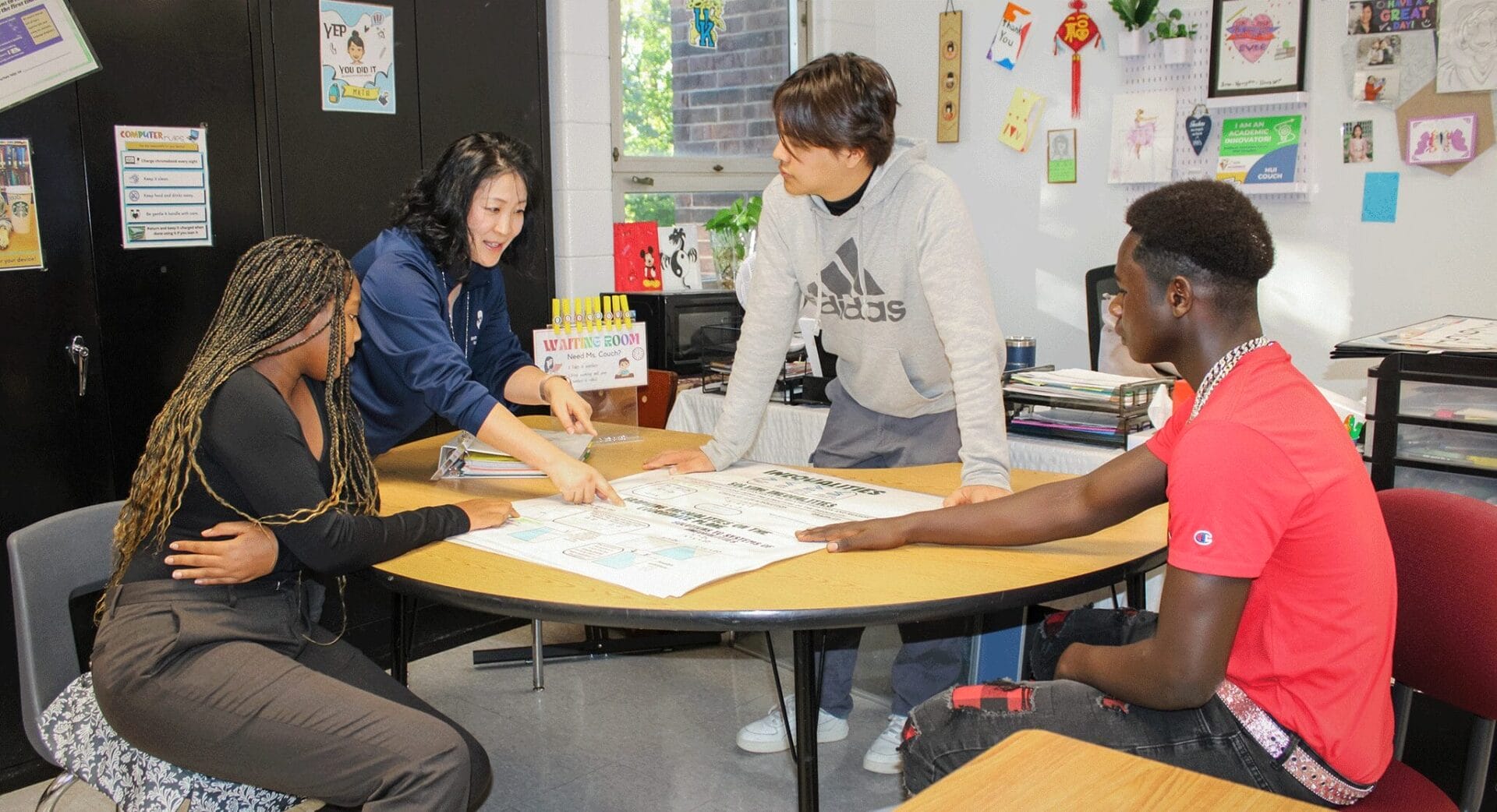
JUAN CORONA MARTINEZ: My math is good now. I feel more confident. I’m a math coach in Ms. Couch’s class. I help my classmates learn. I’m proud of myself.
OBAMA BIJOUX: I love the self-paced learning in Ms. Couch’s class. I also enjoy the group work to do practice problems, because we help each other. Ms. Couch’s class really helped me understand math better. I am a group leader and a class supervisor because I enjoy helping people. It makes me feel more confident.
HANNAH BOWYER-RIVETTE: Reflecting on her first year using the Modern Classrooms Project model, also known as MCP, Hui recalls a memory that perfectly captures the powerful impacts of this approach. From the very beginning, Hui could see the difference. The self-paced mastery structure not only challenges students but also gives them ownership of their learning and a space to feel confident in mastering each topic.
HUI COUCH: I will never forget my first year using MCP. Two students turned their learning into a friendly competition. They moved six or seven lessons ahead of all other students. The best part was that these two students did not just speed ahead; they mastered every skill we had learned. And I remember from fall to winter, each group by more than 20 points on our district math MAP testing. I was very proud of them, but not only because of the scores, but also of the motivation and confidence they developed with the MCP.
As for those students who really need more time in their learning, they do not feel the stress of trying to keep up with anyone else. They can move at a pace that works just for them. As a teacher, the biggest win is targeted support. I have more time to work one-on-one with the students who feel confused or overwhelmed. What I love most is the ownership. Students have ownership of their own learning.
When they get ahead of pace, they’re so excited, they quickly move their names forward on our public pacing tracker on the whiteboard, and you can see how proud they are when they earn a proficiency level of four on a mastery check. The joy on their faces is just incredible. You can hear them say “Yes!” with so much confidence. Some literally just jump out of their seats. It’s amazing. These moments always light up my days.
"For me, the most rewarding part of the Modern Classrooms Project (MCP) is watching my students grow, not only in math, but in their confidence and the independence of their learning. MCP hasn't just transformed my students' learning, it has transformed my teaching too.
Hui Couch
HUI COUCH: I feel more successful, more enjoyable being a teacher, and honestly, more inspired in the classroom than I ever did before.
HANNAH BOWYER-RIVETTE: In Hui’s classroom, diversity is celebrated and central to learning. With nine different home languages, she intentionally creates an inclusive environment. She uses images and examples that reflect students’ cultures, adds multilingual captions to videos, and designs math problems and projects rooted in real-world experiences to ensure all students feel represented and connected to their learning.
HUI COUCH: I truly believe that the diversity of languages in my room is our greatest asset. This year, I actually have nine different home languages in the class. My teaching method is really two-fold. At the beginning of the year, I learn to pronounce every name correctly. It’s a simple but powerful sign of respect. Even though I mispronounced the name, which often happens, students were all excited to teach me, and we celebrated that moment when even the teacher makes a mistake.
So we build a class culture that making mistakes is proof of learning to everyone. I also work hard to create an inclusive learning environment using names, examples, or images that reflect a student’s cultures in our learning content. About how I design my instruction to make every lesson accessible. I post language objectives with the sentence terms aligning with the learning target, so students know how to express themselves in English during their discussions in groups.
I use visuals like pictures, anchor charts, and math vocabulary flashcards to help them. I scaffold activities by simplifying questions, breaking hard questions down into smaller, easier pieces, and translating keywords, concepts, or instructions when needed. I anchor problems in our real life, so the math feels related to students. I also record my own instructional videos and add multilingual captions so students can listen to me in English and read in their home languages.
That way, they build their English and understand the content at the same time. So I like to use a think-pair-share so students can get more time to think, jot down ideas, and practice with a partner before sharing with the whole class. In small group work, I intentionally group students by mixing both language and content abilities so students can learn from each other. So this structure really gives my multilingual learners a low-pressure way to process and participate.
I also accept multimodal responses on a mastery check. If a student isn’t ready in English, they can draw it, map it out in a graphic organizer, if they want to, or explain their thoughts to me verbally. I also allow them to refer to their guiding notes during mastery checks if they need to. This really keeps language from becoming a barrier for them to demonstrate their mastery, and the payoff is incredible.
"I have watched the students who started the year silent become more confident and active participants now, and the way they show empathy for one another really proves we are a learning community."
Hui Couch
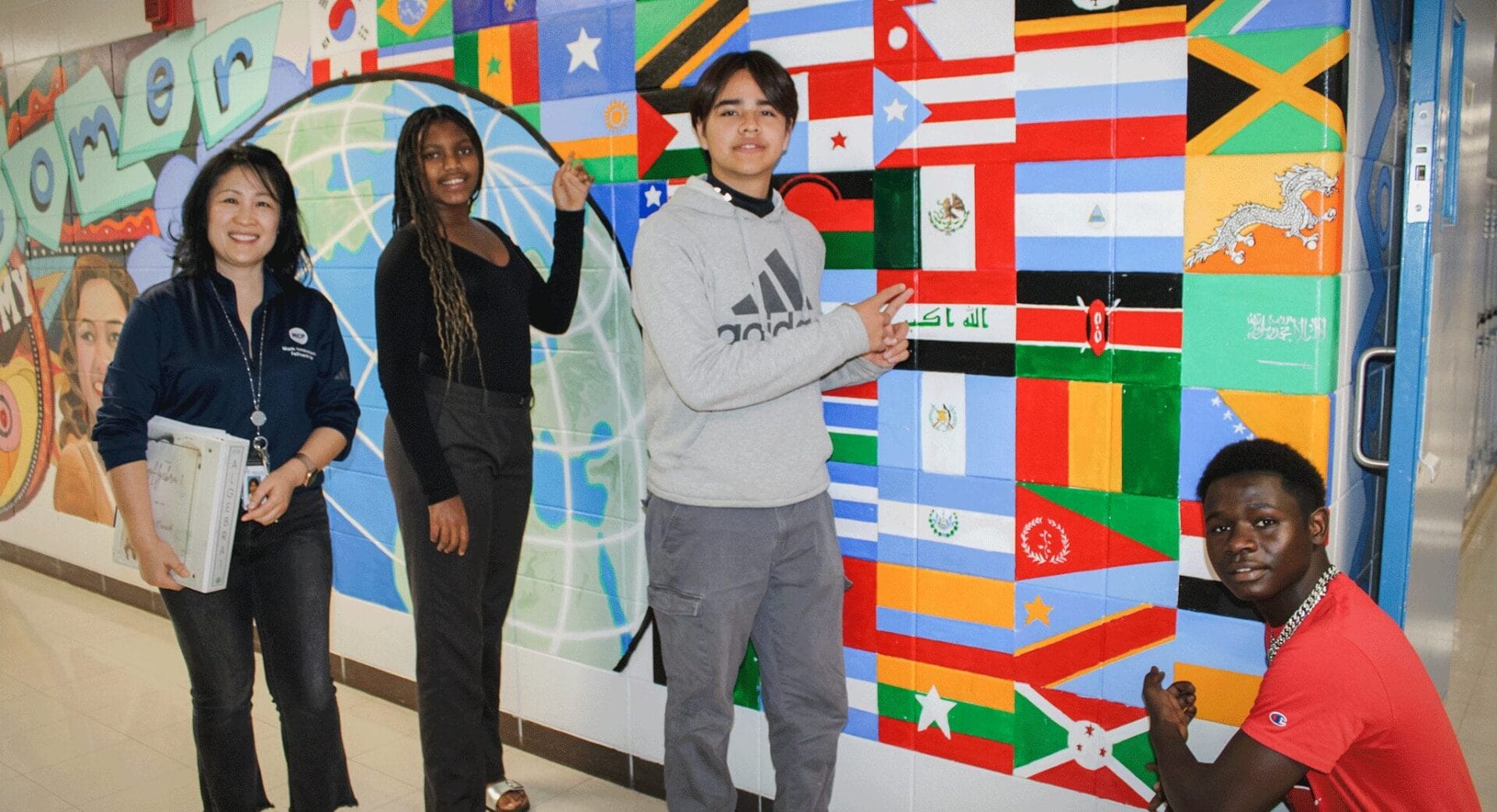
HANNAH BOWYER-RIVETTE: Hui’s students, Obama, Kelia, and Juan, talk about the joy and pride they feel in improving their English skills. They love the Modern Classrooms Project structure where they can work in groups, with partners, and then share ideas with the whole class. They know that no matter if they make mistakes, Hui will always encourage them, celebrate their progress, and support them in the learning process.
OBAMA BIJOUX: I really enjoy Ms. Couch’s weekend check-in activity. I like her picture word band and the sentence starters. It is easy to talk about what we did and how we felt. I love Ms. Couch. We sing English songs and then learn English. Then we play a game, eyes closed, throw the soccer ball, and see who catches the ball, choose a partner to talk about how their weekend was. It is fun, and it has made me more confident to speak English. I love to present my project in class. Ms. Couch said I did an excellent job, and I am very proud.
KELIA AKARIZA: I like that Ms. Couch lets us practice English first thing, then talk with a partner, and at last, share with the class. I feel comfortable to talk in English in that way. Ms. Couch has a secretary, and I answer the phone calls in English in our class. Ms. Couch said I did a good job, and I’m so happy and proud.
JUAN CORONA MARTINEZ: I enjoy Ms. Couch’s class think-write-pair-share most. I can think first, then write and talk with a partner, and finally share with the whole class. I feel prepared. I am not scared of making mistakes. Ms. Couch encourages me to share my ideas in English in class. I like speaking in front of the class now.
HANNAH BOWYER-RIVETTE: Building on the power of a multilingual classroom, Hui discusses the empathy that is fostered by a culturally diverse learning environment. Her students learn to connect across language barriers and navigate differences with curiosity and respect.
HUI COUCH: I see benefits every day that really go far beyond the classroom. Academically, their math thinking grows because they are constantly exposed to different perspectives, and they learn quickly that there isn’t only one way to approach a problem. Socially, they develop real empathy and strong communication skills. They learn to listen closely and find ways to connect with classmates from different cultures, even when there is a language barrier. That kind of personal connection is more powerful than any textbook lesson on diversity. The biggest impact really goes beyond the math.
"This learning environment prepares the students for the real world. They learn to communicate with people from all different backgrounds and build cultural fluency that they cannot get from a textbook."
Hui Couch
HUI COUCH: They start to understand different customs, communication styles, and values, and they learn to navigate those differences with respect and curiosity. Test scores matter, but I believe these human skills, like empathy, adaptability, and critical thinking, are the most positive and lasting impacts they will take with them to their future life.
HANNAH BOWYER-RIVETTE: Hui’s classroom motto is: “Unlocking solutions, one problem at a time.”. During our conversation, she reflects on what this means to her and how this shows up in her teaching. She uses this motto to look forward and take every moment as an opportunity for growth. Hui encourages her students to carry this mindset to give them the confidence to overcome personal and academic challenges.
HUI COUCH: To me, “unlocking solutions, one problem at a time” means every challenge, big or small, is an opportunity for growth. I never rest on my past successes or get stuck on past failures. I’m always looking forward, focusing on the next solvable problems, whether it’s in my own professional development or in helping a student. This philosophy is the agent of my teaching in two key ways.
First, in how I approach my own growth. I’m committed to keeping my teaching updated, so I set small, achievable goals for myself, like learning one new technology tool, trying a new instructional strategy each month. I also reflect on my teaching daily. This is how I tackle outdated teaching, one goal at a time. Second, and most importantly, in how I teach my students. I design my lessons to mirror this. When my students face a daunting math problem, I teach them to deconstruct it.
We do not just look for the final answer. We celebrate unlocking each small along the way. This really builds their resilience and shows them that even the biggest challenges can be overcome through persistent and focused effort.
"So ultimately, it's not just about teaching them math, it's about equipping them with a lifelong problem-solving mindset."
Hui Couch
HANNAH BOWYER-RIVETTE: Hui’s students, Obama and Kelia, share more about how she supports and instills confidence in them. She helps her students break hard questions into easier steps and encourages them to tackle any challenge thrown their way. Additionally, she connects math to the real world so they can apply what they are learning outside the classroom.
OBAMA BIJOUX: Ms. Couch supports me with picture word bank table and sentence starters. I love to work on problems together with her because it breaks the hard question into easier steps. When I make mistakes, she encourages me to try again. She gave me a shout-out for doing a good job. It made me feel very supported and confident.
KELIA AKARIZA: I feel supported because we use math for real life in our pizza party project. We use visuals to estimate the cost, and we need to stay under our budget of $60. Now I can help my family order pizza at home. When I make mistakes or want to give up, Ms. Couch encourages me and tells me she believes in me, and I can do it.
"Class feels accepting, and I am better at explaining my math reasoning. I feel more confident now, even at home, because I know I can do it."
Kelia Akariza

HANNAH BOWYER-RIVETTE: Newcomer Academy is a collaborative learning community where staff members are encouraged to work together to share successes and overcome challenges. Working toward the same goal of helping every student succeed, they cultivate a professional learning environment where everyone can learn from and grow alongside each other.
HUI COUCH: My school is a collaborative community. I also truly believe a strong staff community is a foundation for students’ learning. So I make an effort to initiate collaborative conversations to build a culture of open exchange. For example, when I find a strategy that’s particularly effective, I don’t keep it to myself. I have also learned so much from their teaching methods.
"This process really transforms us from a group of individual teachers into a true professional learning community with one shared goal: helping every student succeed."
Hui Couch
HANNAH BOWYER-RIVETTE: During our conversation, Hui tells a story about a moment that reminds her of her life-changing impact. When working in a different school, she had a student who was struggling with math. Through her support, he gained confidence and improved his academic scores. When Hui left that school, he created a painting for her along with a heartfelt letter that Hui still holds onto as a reminder of the impact one teacher can have.
HUI COUCH: I had a student who was really struggling with math and didn’t have much confidence in math by himself when he came to my class. I invited him to our after-school tutoring sessions, and we worked step by step, using organizers, visuals, and manipulatives, even dancing and singing songs to help make the questions more sense to him. He ended up improving by around 25 points on the last district math MAP testing of the school year. What meant even more was what happened after.
At the district opening day kickoff for all teachers, he thanked me in the student interview video for my help. I was tearful at that moment. All my teaching paid off. When I left that school. I hadn’t told my class I was transferring to another district until the day before I left, because I didn’t like tears. That night, he stayed up painting an Asian picture for me and wrote a letter of thanks.
"Now I keep that painting in my classroom, on the window by my desk. It reminds me why I teach. It truly touched my heart."
Hui Couch
HANNAH BOWYER-RIVETTE: To close out our episode, we hear from Hui’s students, Obama, Kelia, and Juan, about their favorite memories so far in her classroom. From achieving a four on a mastery check to sharing their appreciation for Hui to participating in their school’s global homecoming, her long-lasting impact on these students is clear. Not only is she teaching math and improving their English, but she is also building confidence and fostering connections that her students will carry with them beyond their time in her class.
OBAMA BIJOUX: One of my favorite memories is when I got a four on a mastery check.
"Ms. Couch gave me a shout-out in front of the class and said, 'I told you you are smart and you can do it.' I'd never heard encouragement like that before. I feel proud and thankful. Ms. Couch is a good teacher."
Obama Bijoux

KELIA AKARIZA: The first time I met Ms. Couch, she was so nice to me. She tutored with me and welcomed me. I drew a heart and write “love you” for her, and she put it on her wall. That made me feel really happy. I love Ms. Couch.
JUAN CORONA MARTINEZ: My favorite memory is I love working together with Ms. Couch in the global homecoming parade to represent our culture at the school. In the global homecoming, every person in school is from a different country. And this day we meet, go with Ms. Couch because I help her with decoration, and many things more.
HANNAH BOWYER-RIVETTE: Thank you so much for listening and joining us today to learn more about Hui Couch, our November Honoree and recipient of the Honored National Teaching Award. To read more about his story, you can visit our website at honored.org or click the link in the episode description. If you have a teacher who you want to recognize and nominate for our teaching award, you can head to honored.org/nominate. If you enjoyed today’s episode, you can follow us and leave us a review on whatever podcast platform you’re listening in from. Thanks again for listening, and make sure to tune in later this month to hear a special episode with the CEO of the Modern Classrooms Project.

Photography by Scott A. Wade

Stories you may like

December
Luis
Durán
Talcott Fine Arts & Museum Academy
Chicago, IL

October
Omar
Lisojo
Dover High School
Dover, NJ

September
Jennifer
Garner
Honored Advocate for Teachers Award
Charleston, WV
December
Luis
Durán
Talcott Fine Arts & Museum Academy
Chicago, IL
October
Omar
Lisojo
Dover High School
Dover, NJ
September
Jennifer
Garner
Honored Advocate for Teachers Award
Charleston, WV

